Shopping Cart


In Stock
Lithium Batteries
MINI LiFePO4 lithium battery 12.8 V 100 Ah with BMS for campervans and solar
Price €235.00

 My Favorite Products
 Product Comparator Follow Us on:



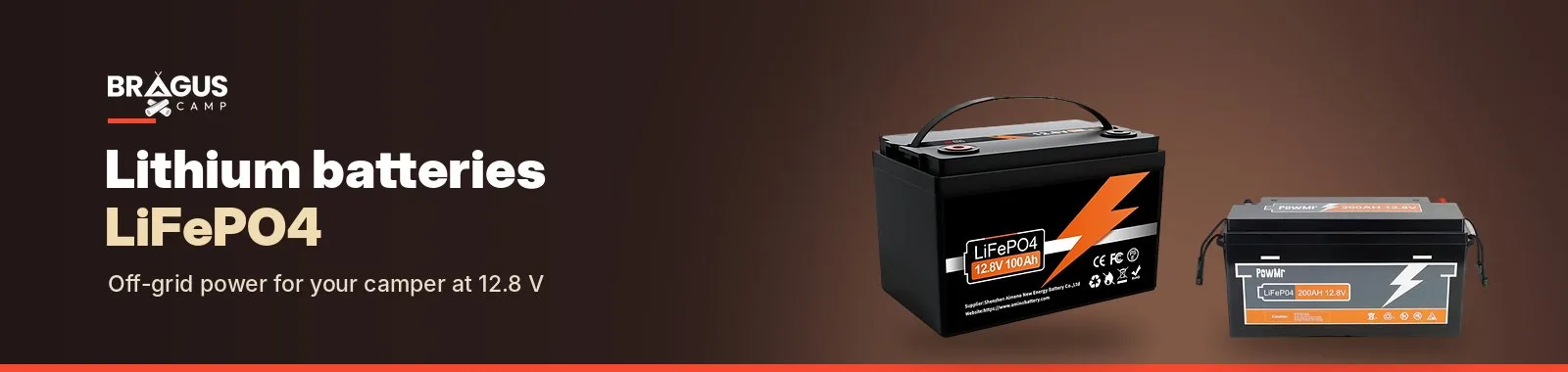
Extend your off-grid autonomy with Braguscamp 12.8 V LiFePO4 lithium batteries: the compact 100 Ah MINI and the 200 Ah PowMr with advanced BMS, designed as leisure batteries for camper vans, motorhomes and solar installations.
Have questions about lithium Batteries or want to know which option suits you best? Message us on WhatsApp and we will advise you with no obligation. Discover more products in the Braguscamp online shop.
The leisure battery is the electrical heart of any camper: it powers the fridge, the lights, the water pump and the charging of your devices while the engine is off. Choosing well is the difference between depending on a campsite and travelling with genuine freedom. That is why at Braguscamp we have chosen LiFePO4 chemistry, today the benchmark for powering vehicles you live in.
Compared with lead-acid batteries, LiFePO4 lithium weighs far less, lets you use a much larger share of its capacity and withstands many more charge cycles. Our batteries run at a nominal 12.8 V, so they fit standard 12 V installations. Both use grade A cells and a BMS that protects them against overcharging and short circuits.
You can charge them from a solar panel with a controller, from the alternator through a DC-DC charger, or with a lithium-compatible mains charger. The 100 Ah MINI stands out for its compact, lightweight format; the 200 Ah PowMr for its large energy reserve and a service life of up to 6000 cycles.
01
Much lighter
They weigh considerably less than a lead-acid battery of equivalent capacity, which makes a real difference to any van or motorhome payload.
02
More usable energy
You can use a far larger share of every amp-hour, so you get more real autonomy from the same rated capacity.
03
Long service life
Grade A cells withstand many more cycles than lead-acid; the 200 Ah PowMr version reaches up to 6000 cycles.
04
Built-in protection
The BMS monitors the battery and protects it against overcharging and short circuits for safe use on every trip.
Start by calculating your daily consumption, adding up what the fridge, lights, water pump and devices draw, then decide how many days you want to be self-sufficient. The 100 Ah model covers weekend trips very well; the 200 Ah is designed for long journeys, van life or systems with an inverter and 230 V appliances. Check the available space as well.
✓ Add up the daily consumption of all your 12 V equipment
✓ Decide how many days you want to travel off-grid
✓ Check your charger, controller and DC-DC have a LiFePO4 profile
✓ Measure the available space: the MINI suits tight installations
Yes, in most 12 V installations, since our batteries run at a nominal 12.8 V. Before switching, check that your mains charger, solar controller and DC-DC charger offer a LiFePO4 lithium profile, and that your wiring and fuses are correctly sized for the system.
There are three methods, which can be combined: a solar panel with a controller, the vehicle's alternator through a DC-DC charger while you drive, or a lithium-compatible mains charger when you are on hook-up at a campsite. Using at least two of them gives you much steadier autonomy.
It depends on your consumption. As a guide, a compressor fridge, LED lighting and phone charging can run for one to two days without any external input. With a solar panel recharging during the day, that autonomy extends considerably.
The 100 Ah MINI is ideal for weekend trips and vehicles with limited space. The 200 Ah PowMr is designed for long journeys, life on board or systems with an inverter and 230 V appliances. If in doubt, send us your consumption figures and we will help you size it.
The BMS, or battery management system, constantly monitors how the battery is working and protects it against overcharging and short circuits. It is what allows a lithium battery to operate safely and keep its performance throughout its service life.
Far more than a lead-acid battery. Both models use grade A cells built for a long service life, and the 200 Ah PowMr reaches up to 6000 cycles. In practice, that means many years of travel with stable, reliable capacity.
As a general rule, only identical batteries should be combined: same model, same capacity, same age and the same state of charge before connecting them. Use cables of equal length and cross-section and the right protection. Mixing different batteries unbalances charging and shortens their service life. Before expanding your system, check the product page or write to us with your wiring diagram and we will advise you.
They can discharge in the cold, although the available capacity drops temporarily. The key precaution is charging: as a general rule, a LiFePO4 battery should not be charged below 0 °C. That is why it is best installed inside the living area, the warmest and best-insulated part of the vehicle, rather than underneath the chassis or in the engine bay.
Ideally in a dry, protected interior location, such as a box under a seat or inside a cabinet, close to the main loads to keep cables short. Secure it firmly so it cannot move while driving, leave space around it to check the connections and fit a fuse close to the positive terminal. The 100 Ah MINI stands out for its compact format for tight spaces.
Yes. The 200 Ah PowMr is designed precisely for installations with an inverter and 230 V appliances, as it offers a large energy reserve. Choose a pure sine wave inverter with the right power for your equipment, and size the cables and fuse correctly, because the current on the 12 V side is high with heavy loads.
With lead-acid batteries, it is recommended not to discharge more than roughly half of their capacity to avoid damaging them. LiFePO4 lithium lets you use a much larger share of every amp-hour without harming its service life. So with the same nominal capacity you get considerably more real autonomy, and a lithium battery can replace a larger lead-acid one.
Grade A cells are the highest-quality cells in lithium cell production: they meet their rated capacity and behave consistently with one another. That uniformity means the battery balances better, performs steadily and achieves a long service life. Both the 100 Ah MINI and the 200 Ah PowMr use grade A cells.
Leave it at an intermediate charge level rather than completely full or empty, and disconnect all loads, including small parasitic drains, using the isolator switch or by removing the main fuse. Store it somewhere dry and protected from extreme temperatures. Check the level from time to time; a solar panel with a controller can help you maintain it.
It depends on your daily consumption and the time of year you travel. Calculate the Wh you use per day and choose a panel output that replaces them in the available hours of sunshine, with a margin for cloudy days. Use a controller with a LiFePO4 profile; MPPT controllers make better use of the panel's energy. Write to us with your consumption and we will help.
Camper Accessories Camper Accessories Charging Stations Windows and Skylights Camper Fridges Thermal Insulation Water Tanks Camping Furniture
Need help choosing?
Our team will advise you, with no obligation, on compatibility, fitting and the equipment that best suits your vehicle.
Save products on your wishlist to buy them later or share with your friends.

